


Squeegee or Blade? Terms, Structure and Selection for Screen Printing Tools
On the shop floor the two Chinese words are used interchangeably. On a drawing, a BOM or a purchase order they are not the same object. Getting it wrong has a concrete cost: the wrong item ordered, the wrong part delivered, a line waiting for material. This article settles the terminology, then covers structure, hardness, edge profile and selection.
1 Two words, two objects
In Chinese industry usage — the convention followed by journals such as Screen Printing Industry — the two terms are distinct:
| Chinese term | Refers to | English | Where it is used |
|---|---|---|---|
| 胶刮 | the complete tool: blade + clamp + aluminium or wooden holder | squeegee (assembly) | drawings, BOM, manuals, technical documents |
| 刮胶 | the PU rubber strip alone, a consumable | squeegee blade / rubber | purchasing, material requisition, spares list |
| 刮刀 | loose term for whatever performs the stroke | squeegee / doctor blade | spoken usage, process discussion |
English makes no such distinction — the assembly and the rubber are both “squeegee”. So English documents are safe with one word; Chinese has to pick the right level.
The rule in one line: write 胶刮 for the assembly with a holder, 刮胶 for the rubber strip alone. Shops and suppliers often call the strip 胶刮 in speech; judge by context there, but keep the two separate in writing.
2 Anatomy: why the assembly and the strip are not interchangeable
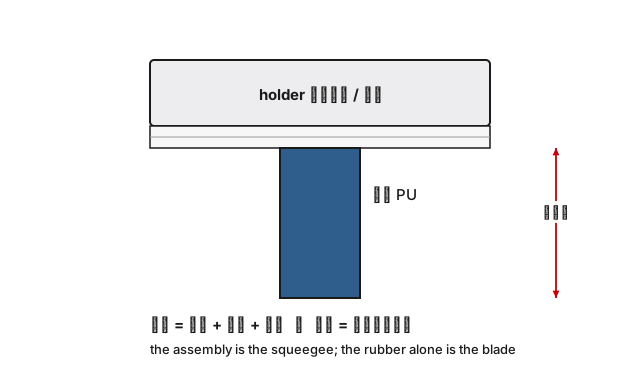
The section held by the clamp does not deform; only the exposed length does the work. Exposures of 15–25 mm are typical: longer feels softer and follows uneven substrates, shorter feels harder and suits thin films and fine detail.
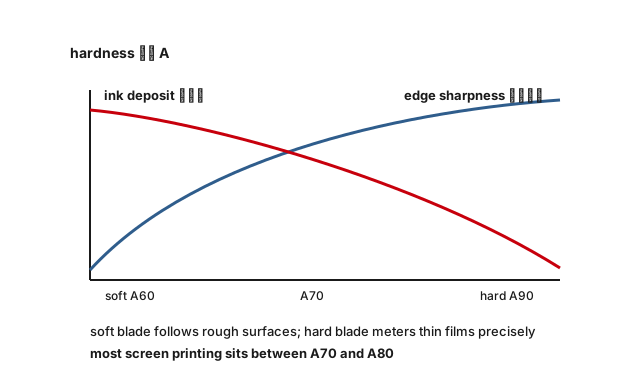
This explains a common confusion — the same A75 rubber can behave completely differently on two holders. The nominal figure is material hardness; what prints is effective hardness.
3 Material and hardness
Screen printing blades are almost all polyurethane, graded on the Shore A scale, typically A60–A90, with A70–A80 covering most work.
| Shore A | Suits | Watch out for |
|---|---|---|
| A60–A65 | coarse fabric, curved surfaces, heavy deposit | edges slump; not for fine lines |
| A70–A75 | general textile printing, packaging | the safest starting point |
| A80 | fine graphics, thin films, high mesh counts | sensitive to substrate flatness |
| A85–A90 | glass, ceramic, PCB thick film | needs high-tension screens |
PU is vulnerable to strong solvents. Prolonged contact with ketone or ester inks swells the blade, softens it and fuzzes the edge — the print suddenly gets heavier and the edge goes soft. A new blade often fixes it faster than any parameter change. Test: measure the length. A swollen blade runs 1–2 mm long.
4 Edge profile: three types, three jobs
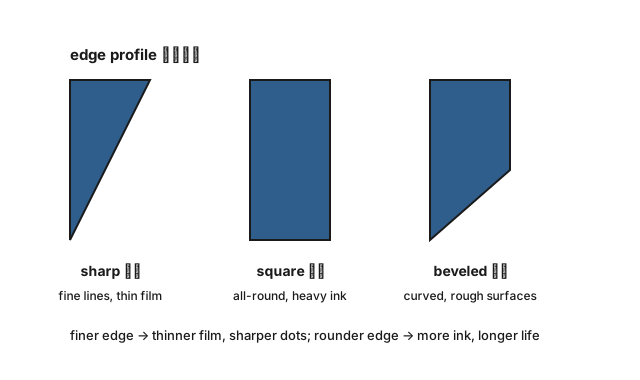
Sharp tapers to a fine line: small contact area, concentrated pressure, good for 0.1–0.3 mm lines and thin films, but it wears fast and chips easily.
Square has a rectangular edge: large contact area, stable deposit, the general choice, and the easiest to regrind.
Beveled or round spreads pressure more gently, suits curved surfaces, coarse fabric and heavy deposits, and lasts longest at some cost in edge definition.
5 Profile, thickness and ink deposit
Common blade sections are 50×9 mm, 40×10 mm and 35×7 mm. Buyers tend to fixate on thickness, but deposit is set by four things together:
With mesh and ink fixed, the order of adjustment should be: exposure first (change the holder or shim), then squeegee angle, and pressure last — because pressure also distorts the screen and accelerates blade wear.
6 Working with mesh and ink
| Condition | Blade choice | Why |
|---|---|---|
| High count (250+) | hard A80+, sharp or square | small apertures need concentrated pressure |
| High-viscosity ink | hard, slower stroke | longer low-shear dwell before structure rebuilds |
| Heavy deposit required | soft A60–A70, beveled | larger contact area, more ink |
| Rough or curved substrate | soft, beveled, longer exposure | must follow surface variation |
| Fine lines and halftones | hard, sharp, shorter exposure | reduces edge pull-back and fill-in |
For the underlying mechanics see Screen Printing Mesh (off-contact and snap-off) and Screen Printing Ink (viscosity, thixotropy, surface energy).
7 Maintenance and retirement
8 Writing it correctly
Why it matters: order “squeegee A75” and a supplier may quote the complete assembly; order a “blade” and ask for a handle and they will assume you do not know the trade. Precise terms are not about tidiness — they save a round of confirmation.
Companion reading: Screen Printing Mesh · Screen Printing Ink · Screen Printing Terms Explained


