


Screen Printing Terms Explained
The words used on the shop floor every day, rewritten as definition, criterion and common mistake. 33 entries, Chinese and English side by side.
Why this glossary exists
Much of the cost of communication in screen printing comes from one word meaning different things in different processes. “Tension” is a Newton reading at the stretching station but often describes registration drift in a production meeting; “ink deposit” is quoted wet by some and dry by others, a difference of about a third. When terms are not fixed, parameter discussions drift and rework starts there.
This list does one thing: give each word a checkable definition, then add the point most often misjudged. Entries are grouped into six process areas and can be used for onboarding, supplier communication and aligning language in quality meetings.
Screen and stencil网版与制版
- Mesh count网目数
-
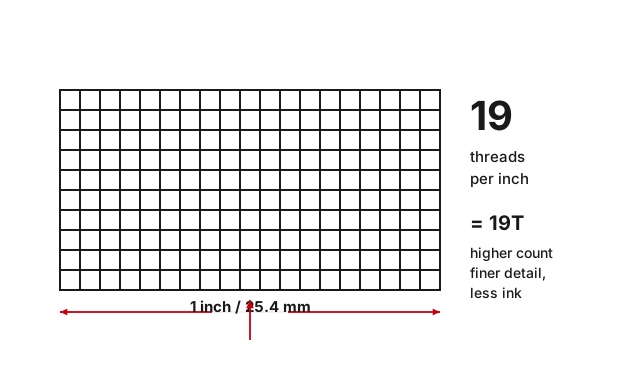
The number of threads per inch or per centimetre of mesh. It sets the finest line and smallest dot the screen can reproduce; higher counts mean smaller apertures and less ink deposit.
Watch outAlways state whether the count is per inch or per centimetre — the two differ by a factor of 2.54 and are the most common source of quoting errors.
- Thread diameter丝径
-
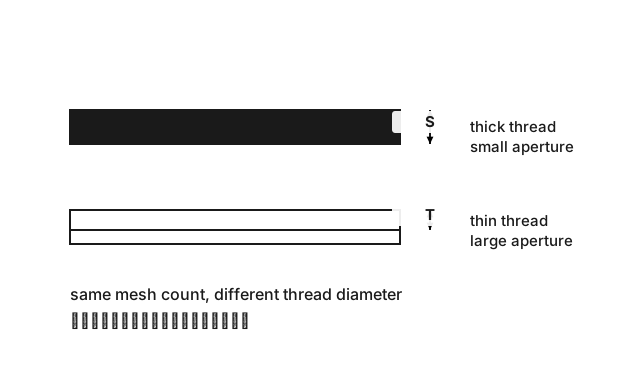
The diameter of a single thread, usually given in micrometres. At the same mesh count a thicker thread leaves a smaller aperture, passes less ink, and lasts longer.
Watch outA mesh spec that gives only the count is incomplete: S-type and T-type meshes at the same count can differ by more than 30% in ink deposit.
- Open area开口率
-
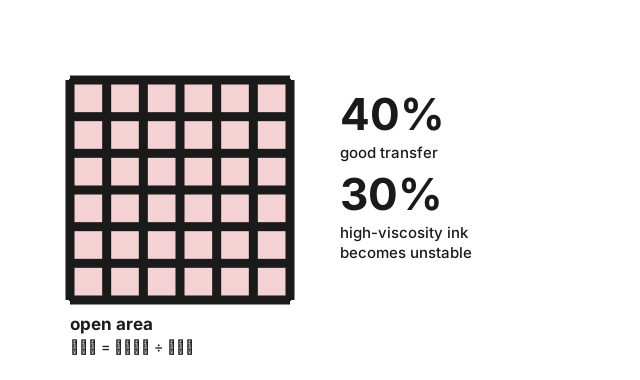
The share of the total mesh surface that is open aperture. It directly sets theoretical ink deposit and is derived from mesh count and thread diameter together.
Watch outBelow roughly 30% open area, transfer of high-viscosity ink becomes unstable and squeegee settings must be adjusted to compensate.
- Mesh tension绷网张力
-
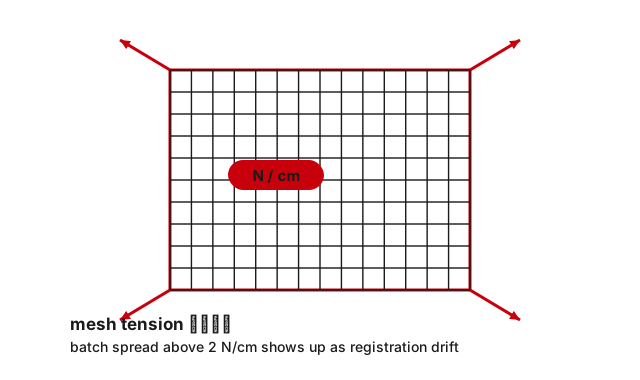
How tightly the mesh is stretched, expressed in N/cm. Insufficient tension causes slow snap-off, registration drift and premature screen fatigue.
Watch outTension should be set by mesh type and frame size; a spread above 2 N/cm within one batch shows up as unstable registration.
- Emulsion感光胶
-
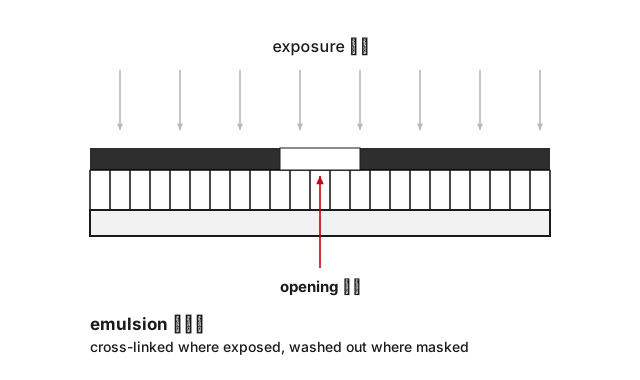
The photosensitive polymer layer coated onto the mesh. Exposure cross-links it into an ink-resistant stencil; the unexposed area washes out during development.
Watch outThe number of coating passes sets stencil thickness, which in turn caps both print run durability and minimum resolvable line width.
- Off-contact distance网距
-
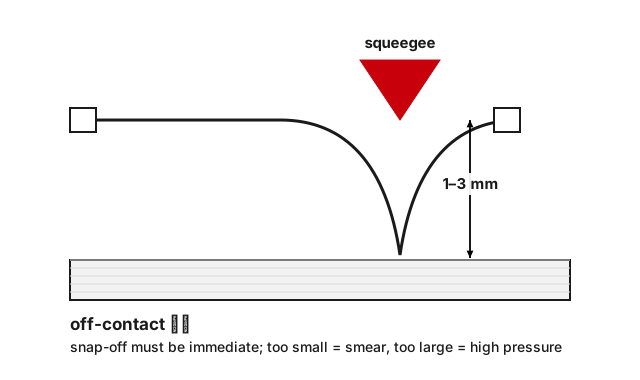
The gap between screen and substrate before the stroke, typically 1–3 mm. Too much gap demands higher pressure; too little causes the mesh to release late and smear.
Watch outOff-contact and tension are a paired setting: higher tension allows a smaller gap, and a mismatch shows up as patchy ink deposit.
- Underexposure and overexposure曝光不足与过度
-
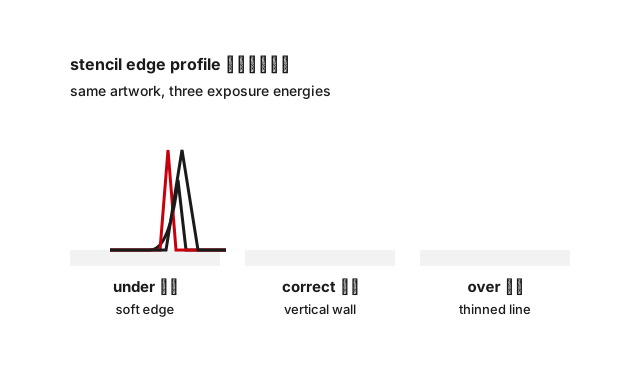
When exposure energy departs from what the stencil needs, edge sharpness is lost: underexposure gives soft edges and stencil breakdown, overexposure thins lines and loses fine dots.
Watch outSet baseline energy with an exposure step test rather than adding time by feel; re-test whenever the emulsion brand changes.
Squeegee and ink transfer刮印与墨层转移
- Squeegee刮刀
-
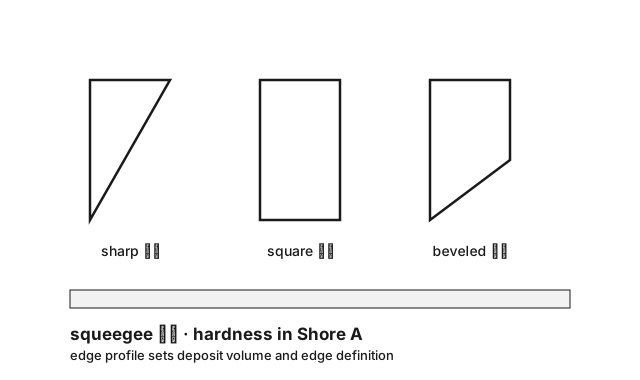
The tool that drives ink through the mesh. Hardness is given in Shore A and edge profile may be sharp, square or beveled; both affect deposit volume and edge definition.
Watch outHarder is not better: hard squeegees suit fine detail, soft ones suit rough substrates, and the wrong choice costs both definition and screen life.
- Squeegee angle刮印角
-
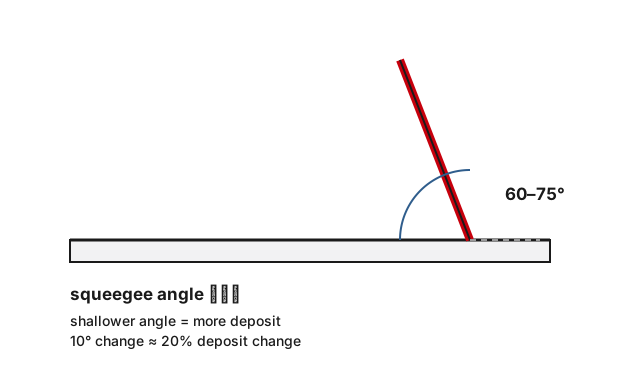
The angle between squeegee and screen plane, commonly 60–75°. A shallower angle pushes more toward flooding and increases ink deposit.
Watch outA 10° change can move deposit by around 20%; when tuning, lock the angle first and adjust pressure second.
- Squeegee pressure刮印压力
-
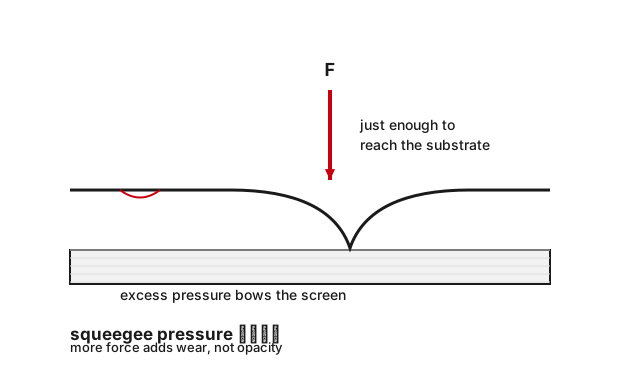
The downward force applied through the squeegee. It only needs to bring the screen into contact with the substrate; excess pressure distorts the screen and leaves a centre-heavy deposit.
Watch outAdd pressure until the print is complete and stop there; further pressure only wears the screen without improving opacity.
- Ink deposit墨层厚度
-
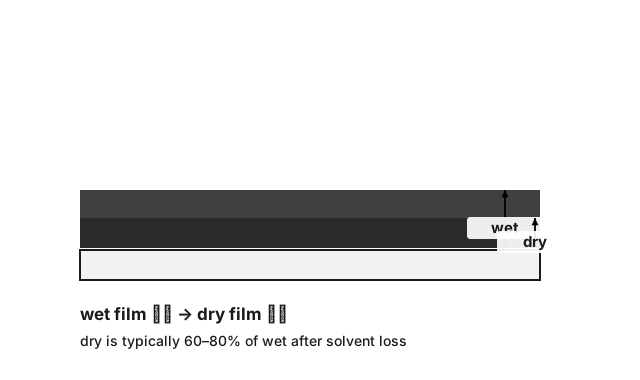
The thickness of ink on the print, quoted either wet or dry. Dry thickness governs opacity, hand feel and wash durability.
Watch outWet and dry figures are not interchangeable: after solvent loss the dry film is usually 60–80% of the wet film.
- Opacity遮盖力
-
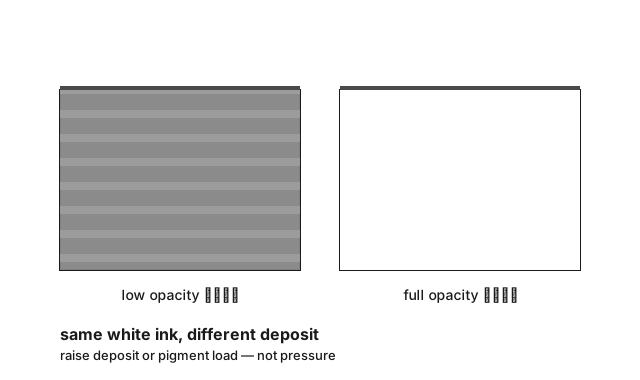
The ability of the ink film to hide the colour beneath it. For light ink on dark substrate, opacity matters more to appearance than hue does.
Watch outRaise opacity by increasing deposit or switching to a higher-opacity pigment; extra squeegee pressure will not do it.
- Thixotropy触变性
-
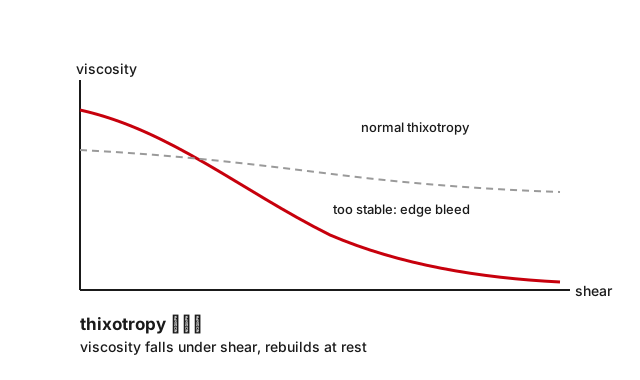
The property of ink thinning under shear and rebuilding when left to rest. Excessive thixotropy makes viscosity fall during a run, causing edge bleed.
Watch outDo not fix abnormal thixotropy with reducer — it breaks the structure further. Check ink temperature and how it was stirred first.
- Leveling流平
-
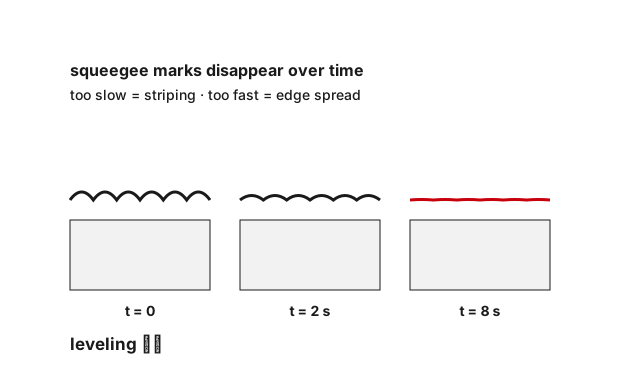
The ability of the wet film to spread and erase squeegee marks after printing. Too little leaves striping; too much spreads the edge and thickens lines.
Watch outLeveling depends on substrate surface energy, ink viscosity and ambient temperature; identify which one has changed before adjusting.
- Mesh clogging堵网
-
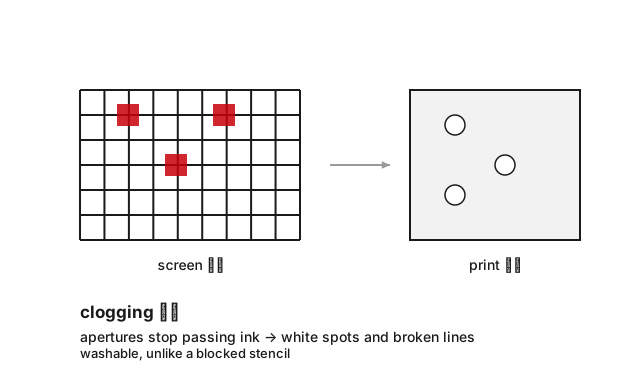
Ink drying or agglomerating inside the apertures so that area stops passing ink, producing white spots or broken lines on the print.
Watch outDistinguish clogging from a blocked stencil: the first can be washed out, the second means the screen is finished, and confusing them causes repeated stoppages.
Registration and geometry套印与几何精度
- Registration套印
-
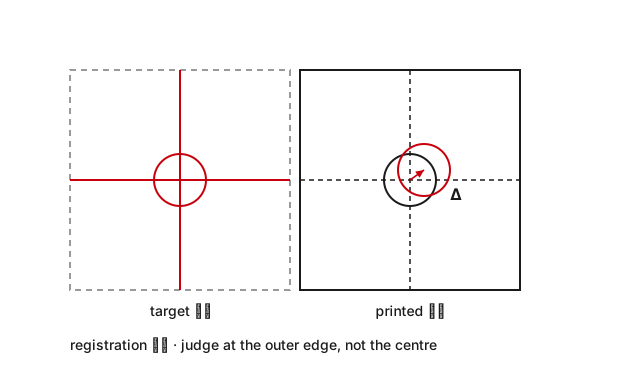
The positional accuracy between colours in multi-colour work. Registration error is measured at the outermost edge, usually in millimetres or in 0.01 mm units.
Watch outJudge registration at the outer edge, not the centre: a print centred but drifting at the edge still reads as misregistered in use.
- Registration drift跑版
-
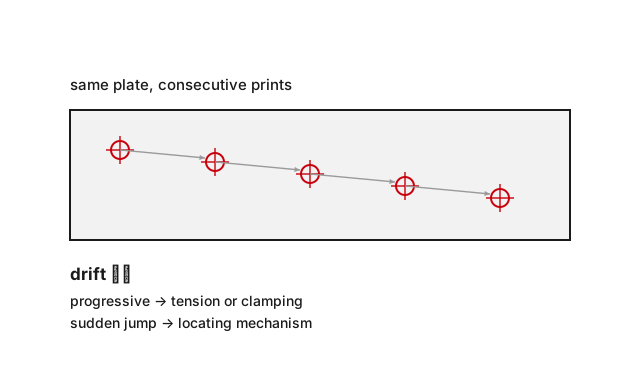
Progressive shift of print position during a run, usually caused by falling mesh tension, a loose pallet or substrate deformation.
Watch outProgressive drift points to tension and clamping; a sudden jump points to the locating mechanism. The two need different responses.
- Stretch and shrinkage涨缩
-
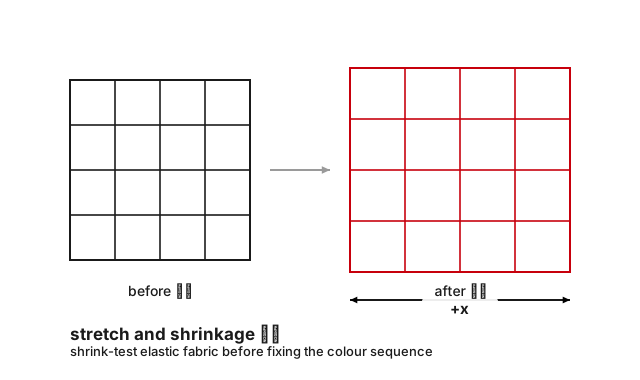
Dimensional change in the substrate after printing, drying or washing, so later colours no longer line up with earlier ones.
Watch outRun a shrink test on elastic fabric before fixing the colour sequence; placing the largest colour area last reduces the effect noticeably.
- Repeat positioning accuracy重复定位精度
-
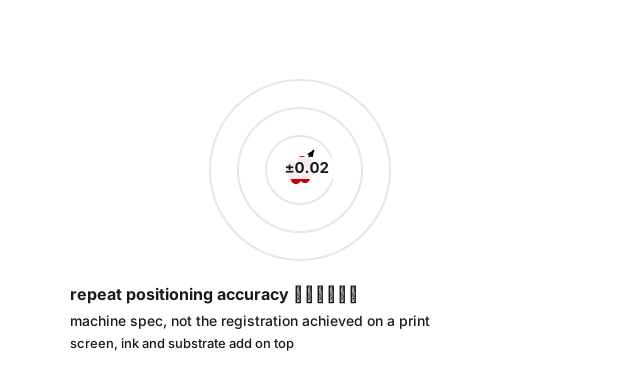
How consistently a machine returns to the same position, quoted as a deviation range such as ±0.02 mm. It sets the floor for achievable registration.
Watch outThis is a machine specification, not the registration achieved on a print — screen, ink and substrate variation all add to it.
Curing and appearance固化与表面外观
- Touch dry and through dry表干与实干
-
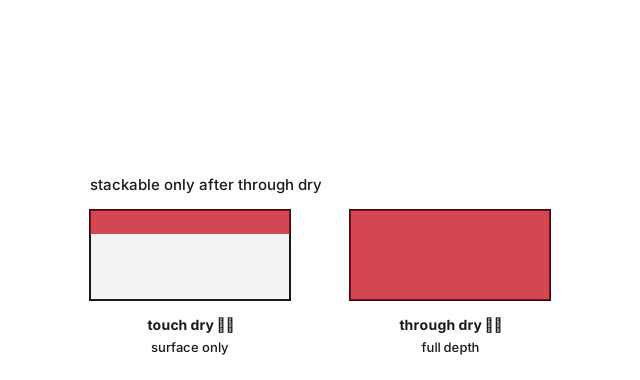
Touch dry means the surface is no longer tacky; through dry means the film is cured to its full depth. Touch dry is not stackable, only through dry is deliverable.
Watch outStacking marks mostly happen in the window between touch dry and through dry; do not size that window from the touch-dry time.
- Curing固化
-
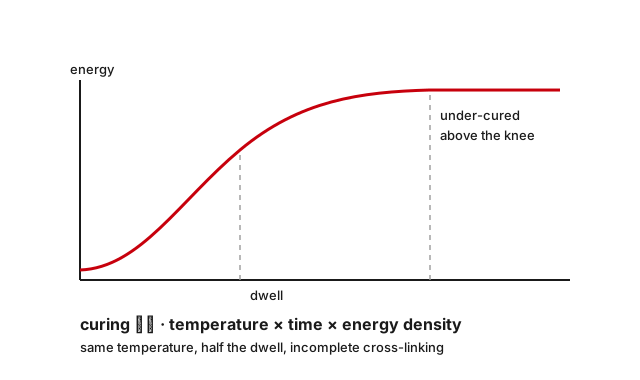
The process of bringing the ink film to its designed performance by heat, radiation or chemical reaction, governed by temperature, time and energy density together.
Watch outTemperature alone misleads: halving dwell time at the same temperature can leave cross-linking clearly incomplete.
- Pinhole针孔
-
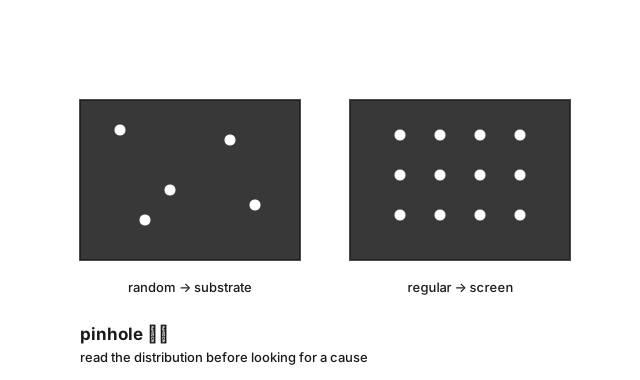
Small holes in the ink film that show the substrate through, usually from particles on the substrate, residue on the screen or air in the ink.
Watch outA regular pinhole pattern points to the screen, a random one to substrate cleanliness — read the distribution before the cause.
- Fisheye鱼眼
-
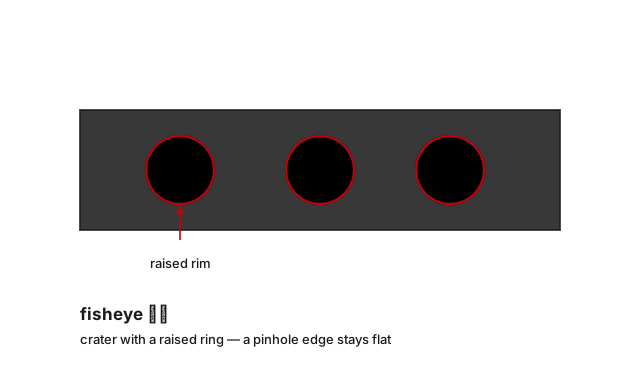
Circular craters where the film has pulled away, often showing bare substrate at the centre, caused by surface-energy mismatch or oil contamination.
Watch outFisheye differs from pinhole at the rim: fisheye has a raised ring, a pinhole edge stays flat.
- Orange peel橘皮
-
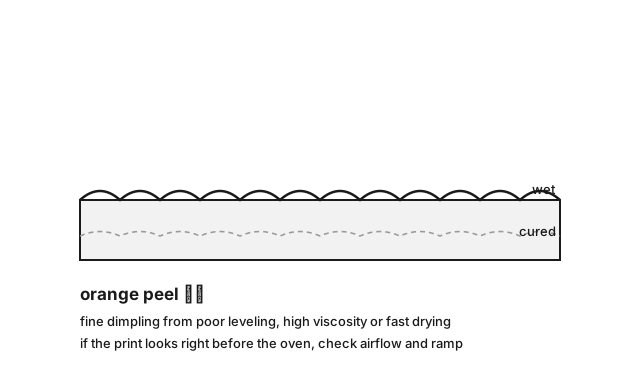
A fine, dimpled surface resembling orange skin, usually from insufficient leveling, excessive viscosity or drying too fast.
Watch outOrange peel usually forms in the drying stage; if the print looks right before the oven, check airflow and the ramp curve first.
- Cracking龟裂
-
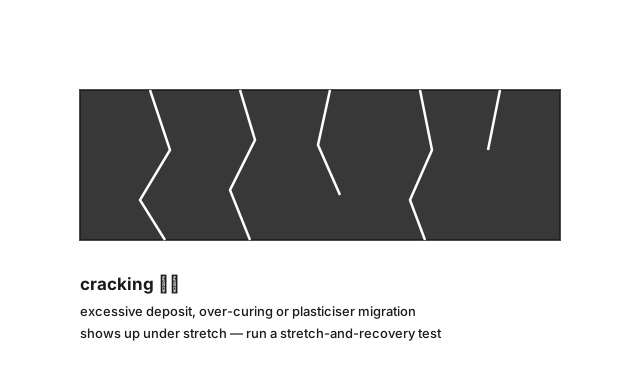
A network of cracks appearing in the film in use or under stretch, typical of excessive deposit, over-curing or plasticiser migration.
Watch outCracking often surfaces only after delivery; for elastic work, run a stretch-and-recovery test instead of judging appearance alone.
Substrate and pretreatment承印物与前处理
- Substrate承印物
-
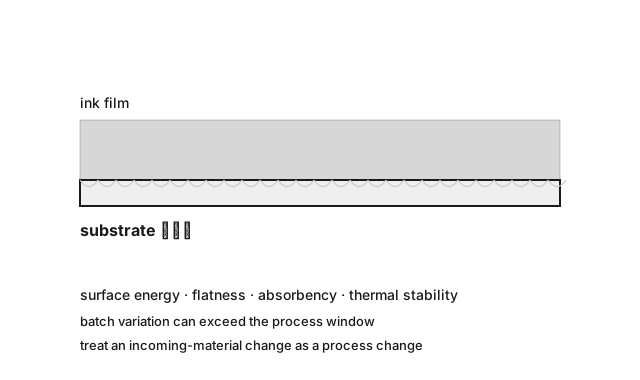
The material receiving the ink. Its surface energy, flatness, absorbency and thermal stability together define how well it prints.
Watch outBatch variation within one substrate name can exceed the process window; treat an incoming-material change as a process change.
- Surface tension and dyne level表面张力与达因值
-
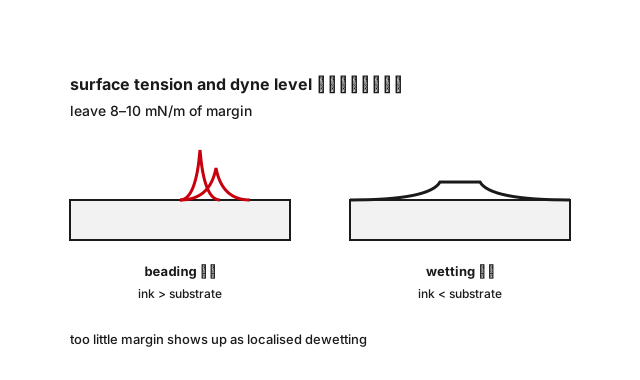
A measure of how readily ink wets the substrate, in mN/m. Ink surface tension must sit below the substrate dyne level for good spreading.
Watch outLeave 8–10 mN/m of margin; too little shows up as localised dewetting rather than overall repellency.
- Pretreatment前处理
-
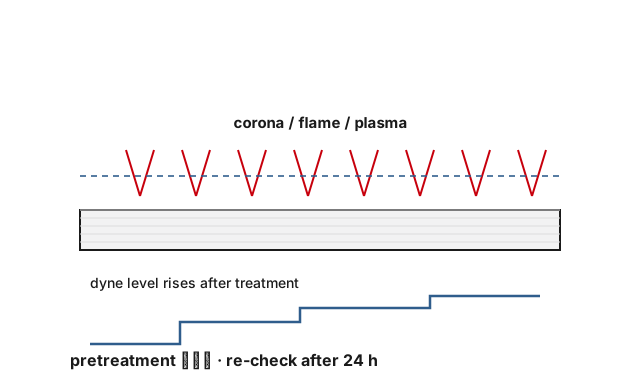
Corona, flame or plasma treatment applied before printing to raise surface energy and remove the weak boundary layer.
Watch outTreatment decays with time; re-check dyne level if more than 24 hours pass between treatment and printing.
- Silicone printing硅胶印花
-
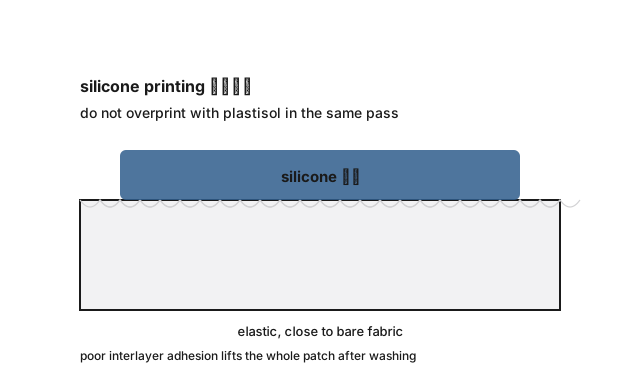
Printing with silicone ink, which gives elasticity and hand feel close to bare fabric with strong abrasion and wash resistance, but demands high substrate surface energy.
Watch outSilicone and plastisol should not be overprinted in the same pass; poor interlayer adhesion causes the whole patch to lift after washing.
- High-density printing厚板印花
-
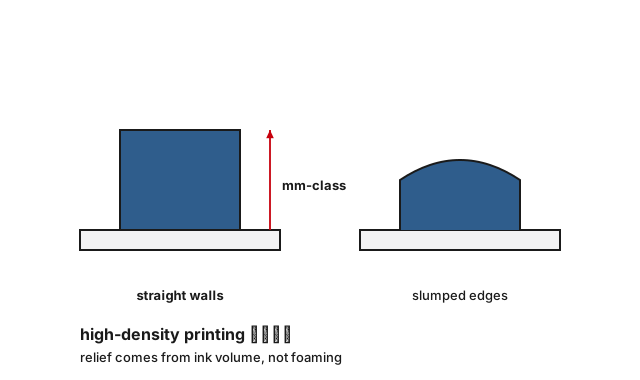
Building a raised ink layer by repeating the print at one position. Deposit can reach millimetre scale, and the relief comes from ink volume rather than foaming.
Watch outEdge definition in high-density work depends on stencil thickness and inter-pass drying; missing either gives slumped edges.
Output and availability产能与稼动
- Print cycle, single and double stroke印次与一刀两刀
-
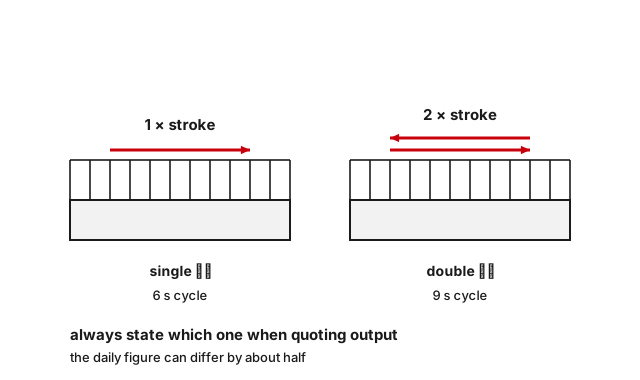
One squeegee pass is one print cycle. A single stroke floods and prints once per pallet; a double stroke passes twice for better deposit and evenness at a longer cycle time.
Watch outAlways state single or double stroke when quoting output: on the same machine the daily figure can differ by roughly half.
- Availability稼动率
-
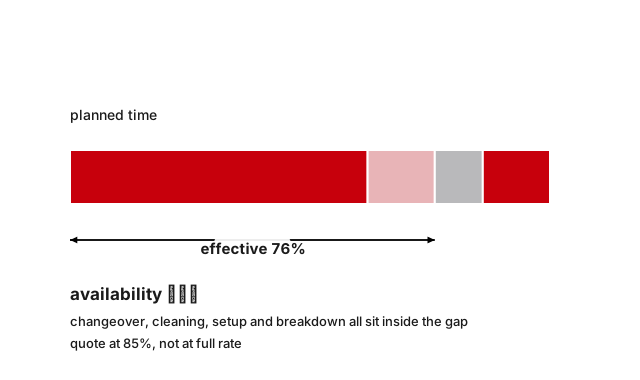
Effective running time as a share of planned time, after deducting changeover, cleaning, setup and breakdown.
Watch outThe gap between theoretical capacity and delivery is almost entirely availability; quoting at 85% tracks reality better than quoting at full rate.
- Pallets per hour and pairs per hour板次与双数
-
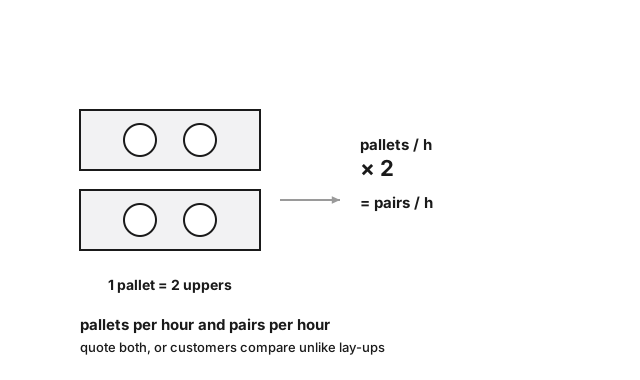
Two ways to state output. Pallets per hour counts pallets completed; pairs per hour multiplies that by the number of uppers laid on each pallet.
Watch outQuote both figures: otherwise customers compare pallet rates across machines with different lay-up density.
Companion reading: Screen Printing Defect Atlas — 27 failure modes with symptom reading, root cause and corrective action.


